
We empathize with our clients' concerns and goals, using that understanding to guide our ideas and actions.
IT systems are tools for keeping our clients' businesses and operations running smoothly.
When building an IT system, understanding the client's business and operations comes first.
We use design thinking to achieve this. For more information about our development process, please click here to learn more.
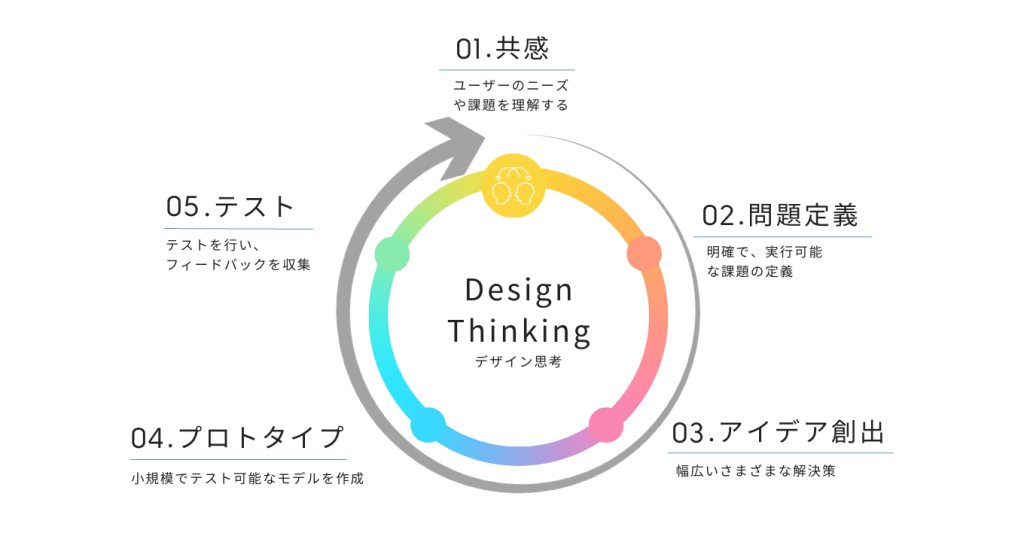
Our projects
begin with design thinking: empathizing with our clients' concerns and aspirations.
1.Understanding users' underlying needs
Through empathy, we develop a deep understanding of our clients' feelings, thoughts, cultural backgrounds, motivations, aspirations and concerns. This allows us to look beyond surface-level problems and explore underlying needs.
2.Broadening our perspective on problem solving
Empathy enables us to look beyond preconceptions based on the functions of our clients' existing systems or our own past experience, and consider solutions from a broader perspective. This lays the groundwork for more practical solutions.
3. Encouraging human-centered UI/UX design
By starting from the user's perspective, empathy helps us move beyond conventional system functionality and propose solutions that bring real value to everyday work and business, such as simple, easy-to-use features and more advanced automation.
The value of face-to-face communication
Not every aspect of business can be easily put into words.
That is why we value face-to-face communication rather than relying on remote communication.
As the saying goes, “Seeing is believing.” By communicating on site, we believe we can understand more than through written exchanges alone and deliver projects smoothly.
Empathy is the starting point of a project and remains essential throughout development and the subsequent period of operation.
We immerse ourselves in our clients' businesses and operations, building a relationship of trust that makes us feel like their own systems department and striving to share their thoughts and feelings.

Once design thinking has deepened our understanding of the client and clarified ideas for concrete solutions, we move to the lean startup process. Through repeated experiments with prototypes, we define the system features to be developed.