
BI solutions
- Home
- portfolio
- BI solution
- BI solutions

BI Solutions
Using data has become essential to decision-making and shared understanding in corporate management.
We respond to these needs by providing BI solutions in many of our contract development projects.
1. Why BI Solutions Are Needed
1. Centralized Data Management
A typical system stores data only to the extent required for its processing.
To create reports for executives and staff to make decisions and judgments, data may need to be collected from several sources.
We provide BI solutions for customers who want to centralize their data in advance.
2. Automated Reporting
Preparing forms and reports for recurring meetings every time is demanding. Collecting data, aggregating and processing it, and distributing reports can easily take several hours. We provide BI solutions for customers who want to automate the output of standard reports.
3. Flexible Analysis
In some cases, modifying the program/Even after no one remains who can review it, operational needs may require continued use. In such cases, insufficient maintenance may cause some data inconsistencies or other issues, yet the system continues to be used within the range in which it still functions.
2. BI Solution Architecture
This section explains in detail the basic functions and roles of a business intelligence (BI) solution.
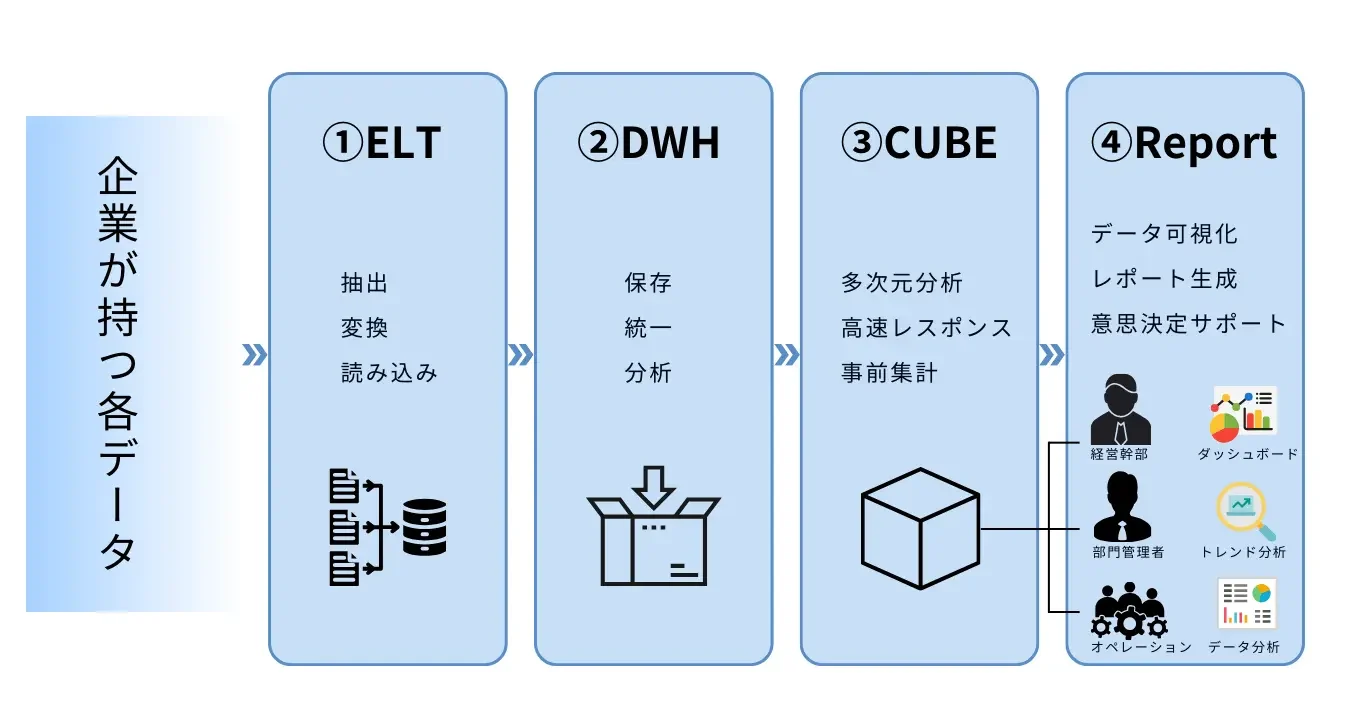
1. ETL (Extract, Transform, Load)
1.1 Extract
- Purpose: Extract data from different data sources.
- Role: Reliably extract the required data from databases, applications, file systems, and other sources.
1.2 Transform
- Purpose: Transform extracted data according to business rules and data quality requirements and standardize its format.
- Role: Clean data, standardize formats, convert values, aggregate records, and otherwise transform it into a quality and format suitable for analysis.
1.3 Load
- Purpose: Store the transformed data in a data warehouse.
- Role: Load data into the data warehouse quickly and reliably and ensure its persistence.
2. DWH (Data Warehouse)
- Purpose: Centrally store data in a standardized format to make analysis easier.
- Role: Store data prepared through the ETL process and make it efficiently accessible to BI tools.
3. CUBE
- Purpose: Enable multidimensional data analysis and provide fast responses to complex queries.
- Role: Store data across multiple dimensions and support data analysis and report generation from different perspectives. Performing aggregation and calculations in advance can significantly reduce query response times.
4. REPORTING SERVICE
- Purpose: Present data visually so that end users can understand it more easily.
- Role: Generate reports and dashboards from data obtained from the data warehouse or cubes, helping business users make data-driven decisions.
These components work together to provide a foundation that allows companies to analyze data effectively and obtain valuable business intelligence.
The ETL process cleans and prepares data before storing it in the DWH. CUBEs then enable fast analysis, and the REPORTING SERVICE ultimately presents information visually to end users.
This enables business users to make faster, more accurate decisions based on data.
3. Features and Strengths of Our Services
1. Concierge Service Backed by Extensive Experience
The best choice among the many BI solutions available depends on each company's circumstances and needs, including the type and volume of data it wants to use and how it wants to report that data. We identify customer needs and propose the optimal plan, considering advanced technologies such as Microsoft's various services and Snowflake as well as open-source software such as Metabase and PostgresSQL.
2. End-to-End Service
Even after finding suitable products for each part of a BI solution, services are often limited—for example, the ETL portion may require separate engineering services. We provide all services required to build a BI solution through a single point of contact.
4. System Implementation and Operation Expertise Developed Through Core System Operations
We have experience implementing and operating core systems that handle data directly tied to company financial results. We apply rigorous project management, including data consistency checks and error detection, to ensure reliable releases and stable operation.