For more information about legacy systems, see this article.
Challenges of Legacy Systems
Because a legacy system must be reconsidered from its underlying structure, rather than focusing on deepening our understanding of the existing system, we understand the existing operations and data and propose a new system using current technology.
We have carried out legacy system upgrade projects at the request of many customers. Although they vary in scale and operational role, they commonly share the following issues.
1.Engineering Talent Issues
Shortage of Successors
An ERP package can centralize data including human resources and accounting information. However, if the supply chain supports a highly distinctive business model, attempting to handle everything with one package can become impractical. Initial implementation and operating costs may grow, or support for every operational area may end up incomplete.
Black Boxes
Over many years, documents and specifications are almost never kept completely current. The more critical the system, the greater the problem when few or no other people understand it.
Insufficient Maintenance
In some cases, modifying the program/Even after no one remains who can review it, operational needs may require continued use. In such cases, insufficient maintenance may cause some data inconsistencies or other issues, yet the system continues to be used within the range in which it still functions.
2. Unable to Keep Pace with Changes in Operations and Business
Retailers generally pursue custom development of their own core systems for the following purposes.
Extensibility
Not enough functions have been added in response to changes in operations and business, and operation within the limits of the existing system has reached its limit.
External Integration
Weak external integration, and especially the lack of real-time integration, makes the system poorly suited to operations and businesses such as e-commerce that require immediacy.
Where the System Can Be Used
The system was developed for office use and cannot support remote work, smartphones, or diverse ways of working.
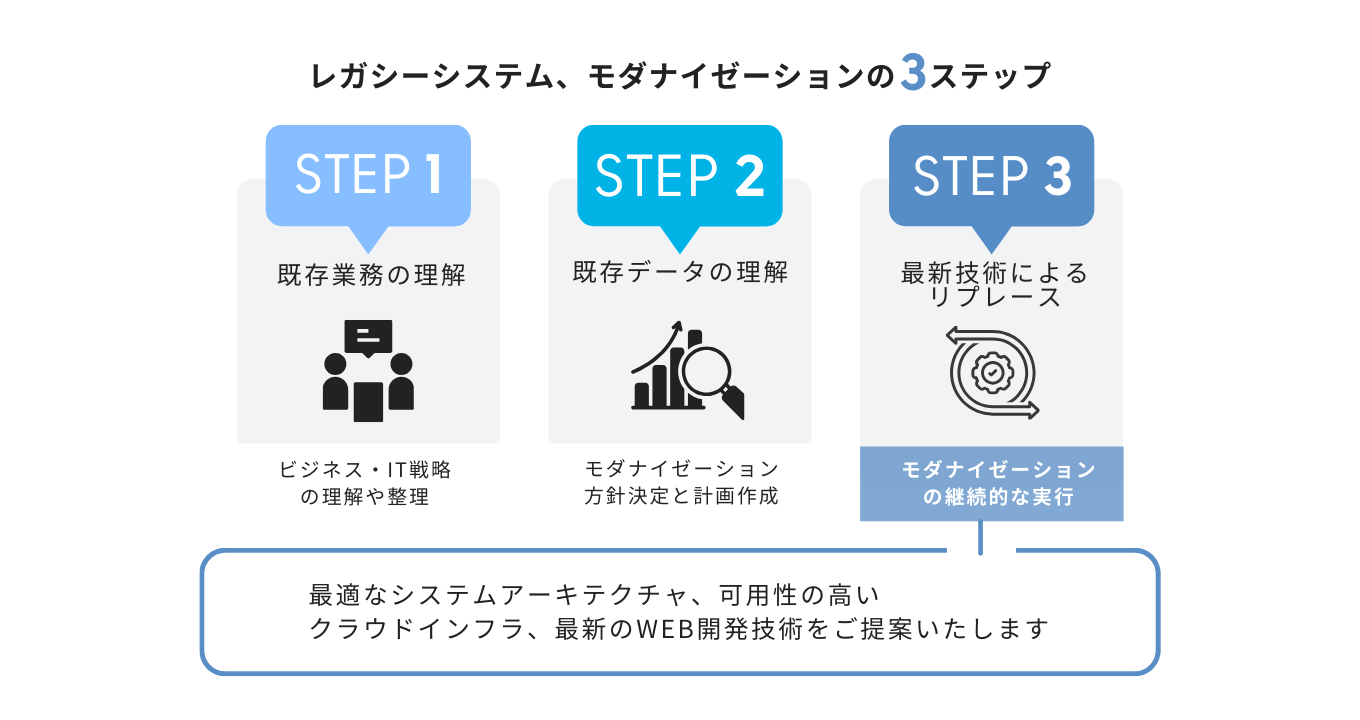
Our Approach to Updating Legacy Systems
1. Understand Existing Operations
We understand the operations performed using the target system, including user roles, permissions,/responsibilities, and workflows, then clarify the system's position within those operations.
2. Understand Existing Data
Data is the lifeblood of a system. We acquire past Input/Output data and validate it through an approach as close as possible to parallel operation, replacing the system while ensuring data consistency.
3. Replace the System with Current Technology
• We propose the optimal system architecture to minimize development and operating costs and operational workload.
• We propose highly available cloud infrastructure while ensuring security.
• We use current web development technologies that maximize development productivity.