
Core business system development — retail, production and wholesale
- Home
- portfolio
- Development
- Systems
- Core business system development — retail, production and wholesale
Replacing Core Systems in the Retail Industry
—Our Approach—
This page explains the role of core systems in retail, our view of the associated challenges, and our approach to replacing core systems.
The Role of Core Systems in Retail and
Our Basic Philosophy
In retail, the work and data involved in managing supply chain management plans and results—such as sales, ordering and purchasing, and inventory—generally make up the largest volume. The mechanism that performs this role is commonly regarded as the core system.
1.The Role of Core Systems in Retail
Using Packaged Software
One advantage of adopting an ERP package is that it can centralize data such as human resources and accounting information, maintaining consistency and enabling efficient operations. On the other hand, if the supply chain supports a highly distinctive business model, attempting to handle everything with one software package can become impractical. Initial implementation and operating costs may grow, or support for every operational area may end up incomplete.
Combining Custom Development with Packaged Software
We recommend building highly distinctive areas through custom development for the company, using packaged software for standard areas, and integrating the two. This approach draws on the strengths of both and aims to create a synergistic effect.
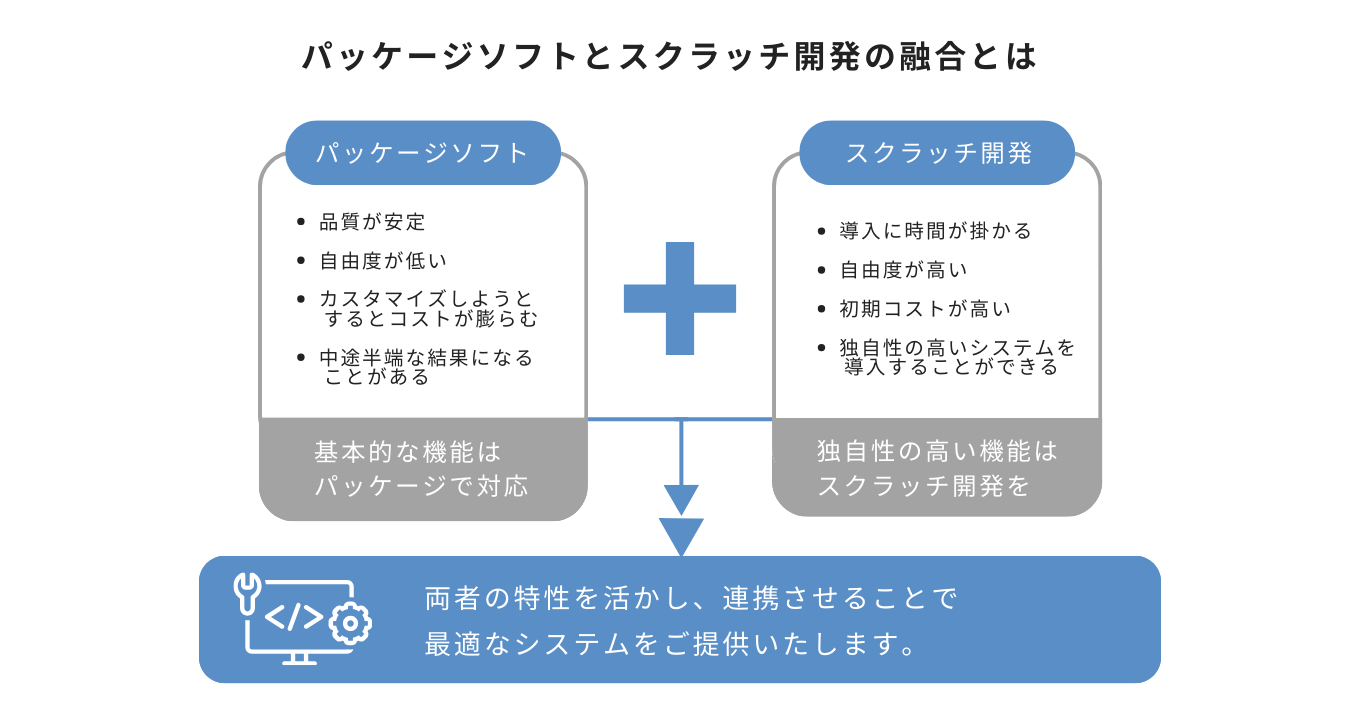
2. Why Retailers Need Custom Core System Development
Retailers generally pursue custom development of their own core systems for the following purposes.
Logistics Optimization
Packaged software easily reaches its limits when a retailer seeks to minimize strain and waste in logistics while making use of several logistics centers and many stores. Using store and logistics inventory in a hybrid way for e-commerce also requires all inventory processing to occur in real time and integrate with the e-commerce front end, creating a need for a custom system.
Optimize Product Information Management Workflows
A single product has many kinds of information that must be managed. When a retailer begins selling private-label products in addition to national brands, or starts selling through e-commerce as well as physical stores, it must accurately register and manage a broad range of information. Roles and workflows are designed to ensure accuracy, but efficient execution requires a custom system suited to the work.
Real-time Management of Plans and Results
Conditions in retail constantly change. Only real-time management of plans and results gives a retailer the responsiveness to change and the ability to make appropriate course corrections. Many systems can produce generic reports, but custom development is better suited to building a platform for freely analyzing and controlling plans and results.
Addressing Obsolescence
When a company maintains its own servers and network, aging equipment requires system renewal on a five- to ten-year cycle. At that point, many companies seek to renew their software as well as their hardware.
We believe there is a large gap between system life cycles and the speed demanded by business and operations. Software should not be replaced merely because hardware is being renewed. Instead, the software platform should allow continuous review as operations change.
When aging hardware creates a deadline, we recommend first moving the system to the cloud, then replacing the entire system in the next step under a sound plan.
Use of New Technologies Such as AI
AI technologies such as chatGPT have advanced rapidly and are now highly practical. These technologies are also open and can be incorporated into a company's own systems. Doing so can automate operations and perform detailed analysis that people might miss. When a company wants to pursue such advanced initiatives, waiting for practical functions to appear in packaged software can take considerable time. Custom development makes it possible to take on the challenge ahead of competitors.
3. Our Approach to Core System Implementation
Core system implementations usually take a long time, often one to two years, and projects that end in failure are not uncommon.
Our approach to ensuring success is as follows.
Do Not Release Everything in a Big Bang
A core system is often composed of hundreds or more functions and supports a wide range of operations.
Problems are likely when both the system and the way work is performed change substantially at the same time.
Even when there is an ambitious future vision, we recommend limiting the first release to existing areas of operation and addressing future improvements in the next step. We work with the customer to create an appropriate roadmap based on the scale of system development.
Build the Optimal System Architecture
We design the optimal system architecture based on the product scope.
Because an optimal system architecture can reduce infrastructure costs and improve development and operating productivity, we examine it thoroughly.
Build One Team with the Customer
We emphasize building one team with the customer while adapting to the customer's style. Correctly understanding the customer's operations is the starting point of a system development project, and our true deliverable is solving the customer's concerns and problems or achieving its goals. To deepen our understanding, we value face-to-face communication and site visits as well as efficient remote meetings. We continue reviewing documents to prevent misunderstandings before beginning development work.
Incremental Development and Testing with Scrum
We use Scrum to execute development projects. We repeat short cycles of two to four weeks, building up the project while producing deliverables. Working in short cycles clarifies tasks, roles, and responsibilities at each stage and allows the project to proceed with appropriate quality and schedule management.
Continuous Data Validation
Data is the lifeblood of an IT system. Our priority is not merely delivering a working program but ensuring correct business operations, so data validation carries substantial weight in our projects. We repeatedly acquire, aggregate, and output production-like data and compare it with the existing system. We completely eliminate missing data and calculation logic errors, and create the preconditions for a confident release by operating the systems in a manner close to parallel production.
4. Our Approach to System Maintenance and Operation
The real work of a core system begins after release. We propose maintenance and operation that aim both for stable system operation and for continued adaptation to changes in business and operations.
Automate Maintenance and Operating Work
We automate the broad range of maintenance and operating work as much as possible, including detecting errors and notifying the responsible staff, monitoring data processing, and managing hardware resources. This addresses the operational and cost burden of maintaining stable service.
Continuous Improvement
While minimizing maintenance and operating work, we allocate any capacity created within the team to improving functions and further automating that work. Instead of treating maintenance and operation as an insurance-like fixed cost that continues without a clear purpose, we make the work visible and strive to contribute to the customer's business.