
Eliminating Waste and Running a Lean, Efficient Project
1. What Is Lean Startup?
Lean Startup is a method for creating a basic version of a product or service with minimal cost and time, then rapidly developing it based on customer feedback. It is widely recognized as a strategy for reducing waste caused by assumptions and creating what customers truly want.
Success requires more than building a product with passion. It requires a deep understanding of actual customer needs and an appropriate response to them. Lean Startup is a strategy that keeps development from becoming an exercise in self-satisfaction and is also described as a next-generation management method that supports the development of new businesses.
Background of Lean Startup
American entrepreneur Eric Ries introduced the concept of Lean Startup based on his own startup experience. His ideas have had a major impact on the business world, and many companies and individuals continue to practice this method today. He shared his experience and knowledge through his blog, Startup Lessons Learned, and has advised many companies on product strategy.
2. The Basic Lean Startup Process
1. Form a Hypothesis
The first step is to form a hypothesis about the business idea. This hypothesis is based on customer needs and market trends.
2. Create a Minimum Viable Product (MVP)
An MVP is the simplest version of a product or service used to test a new idea. At this stage, a product with only the minimum necessary functions is created and released to the market.
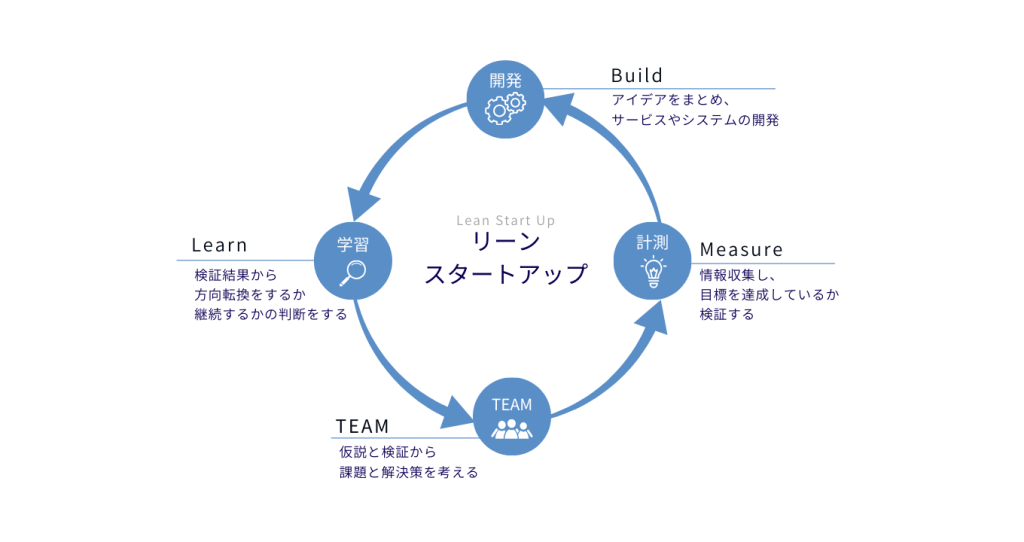
3. Measure and Learn
After releasing the MVP to the market, customer responses and feedback are collected and used to improve the product. This feedback loop is repeated until the product is complete.
4. Pivot or Persevere
Based on the results of measurement and learning, if the hypothesis proves incorrect, a decision is made either to change direction strategically—a pivot—or to continue in the current direction.
3. How to Apply Lean Startup to System Development Projects
3.1 Form a Hypothesis
Through the design thinking process, we form a hypothesis to clarify the value that a new system or function will provide to users and the business.
3.2 Review Using Prototypes and Documents
Waiting until after a system has been developed to validate it means that a great deal of time and effort has already been wasted. First, we create deliverables sufficient for review and discussion with users, then repeatedly interview users to validate whether those deliverables are likely to produce adequate results.
Specifically, we use prototypes such as wireframes and mockups, as well as documents, to validate the hypothesis. Based on these deliverables, we hold feedback sessions with users and stakeholders to confirm the direction of the system.
3.3 Iterative Document Updates and Prototyping
Based on feedback, we update the hypothesis and create another prototype. By repeating this cycle, we gradually narrow down the system requirements and direction before moving into actual development.
3.4 Move into Actual Development
After sufficient review and feedback, we move into actual system development. We continue toward completion through short cycles of releases and feedback, using agile methods where appropriate.