
What is Scrum development?
Scrum development is one method for managing system-development projects. Based on Agile principles, it emphasizes rapid adaptation to customer requirements and market changes and aims to deliver valuable products and features continuously. Projects are carried out through a management method centered on team communication and collaboration and focused on the three pillars of transparency, inspection, and adaptation.
Key Scrum development processes
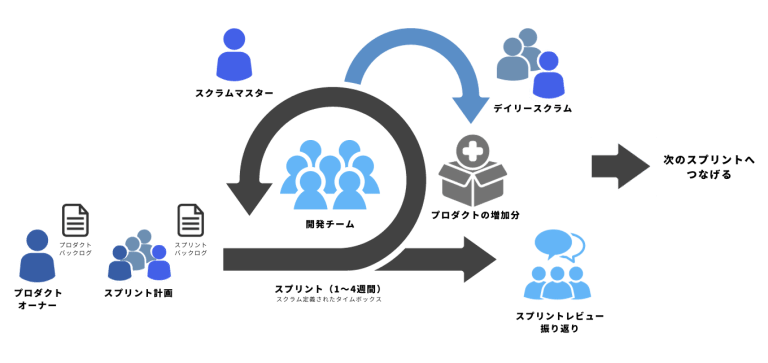
◆ Product Roadmap
A Product Roadmap is a planning tool that presents a product's vision and strategic direction. In Scrum development, a roadmap has the following roles and characteristics.
1. Providing a vision: The roadmap shows the team and stakeholders where the product is headed and why that direction matters.
2. Time-based goals: A roadmap generally lists major product features and goals over time. This helps the team understand future priorities and the direction of investment.
3. Flexibility: In keeping with Agile and Scrum principles, a roadmap is not fixed. It must be updated as appropriate based on market needs and feedback.
4. Stakeholder alignment: A roadmap serves as a communication tool not only for internal teams but also for external stakeholders and management.
5. Relationship to the Product Backlog: In Scrum, the Product Backlog is a list of specific tasks and requirements. The roadmap presents the strategic direction behind that backlog and provides the background and context explaining why particular requirements matter.
Overall, a Product Roadmap presents the future outlook for the system being invested in. It should ideally be prepared by the responsible managers and implemented with management approval. It is an important tool that guides the team and the organization as a whole in the same direction.
◆ Product Backlog
What is a Product Backlog? It is a central artifact in Scrum development that organizes the features and requirements needed to develop a product as a prioritized list.
1. Content: Backlog items are written as user stories, functional requirements, technical tasks, and similar forms. Each item includes information such as value, priority, and an estimate of the effort required.
2. Dynamic nature: The backlog is not static. Items are frequently added, removed, or reprioritized in response to market needs and new requirements.
3. Relationships:
• Relationship to the Product Roadmap: The roadmap is a tool that presents the product's strategic direction and vision, while the Product Backlog breaks that vision down into specific items and tasks. The roadmap shows "what" and "why," whereas the backlog shows "how."
• Relationship to Sprint Planning: At the Sprint Planning meeting, items are selected from the backlog for the next Sprint. The selected items move into the Sprint Backlog, with the goal of having the team complete them during that Sprint.
4. Ownership and management: The Product Backlog is owned and managed by the Product Owner. Through dialogue with stakeholders, the Product Owner sets item priorities and holds refinement sessions with the team to clarify item details and estimates.
The Product Backlog is a central tool that helps the Scrum Team understand the product's direction and clarify what to do next.
◆ Sprint Planning
What is Sprint Planning?
Sprint Planning in Scrum development is an important process in which the team decides what to achieve during the next Sprint and plans the actions needed to do so. This planning meeting is normally held on the first day of the Sprint and is attended by the Scrum Master, Product Owner, and entire Development Team.
Sprint Planning steps:
1. Clarify the objective: The Product Owner proposes the Sprint's objective or goal. This indicates the specific outcome to be achieved or what should have been accomplished by the end of the Sprint.
2. Select backlog items: The Product Owner proposes the highest-priority items from the Product Backlog. The Development Team determines whether it has the capacity to implement the proposed items and selects an appropriate quantity.
3. Break work down into tasks: The selected backlog items are broken down into specific tasks. These may include technical details, design, testing, documentation, and other work.
4. Estimate tasks: The team estimates the time required for each task. This helps determine whether the selected tasks can be completed during the Sprint.
Relationship to the preceding and following processes:
• Preceding process – Product Backlog refinement: This is the process of clarifying backlog-item details and adding or removing items. Items for the Sprint are selected from this refined backlog during the Sprint Planning meeting.
• Following process – Sprint execution: Based on the Sprint Plan, the team performs tasks during the Sprint. Progress is checked at daily stand-up meetings, and adjustments are made as needed.
Sprint Planning is an important phase that begins the Scrum development cycle. Through this planning, the team clarifies the deliverables for the next Sprint and decides on specific actions to achieve them. The work to maximize product value proceeds in close coordination with the preceding and following processes.
◆ Sprint Backlog
What is a Sprint Backlog?
A Sprint Backlog, one of the central elements of Scrum development, is a list of specific tasks the team aims to accomplish during a particular Sprint. It is an important tool managed and used during the Sprint execution, or actual development, phase.
Sprint Backlog characteristics:
1. Selected items: Product Backlog items selected at the Sprint Planning meeting are incorporated into the Sprint Backlog.
2. Task breakdown: The Sprint Backlog breaks each backlog item down into the specific tasks required to complete it. These often include coding, testing, and documentation.
3. Transparency: The entire team can access the Sprint Backlog and see task progress and completion status during the Sprint at a glance.
4. Dynamic nature: The Sprint Backlog may be updated as appropriate when new information or understanding emerges during a Sprint. However, because the work has already moved into an execution phase involving many developers, changes to the Sprint objective or scope should be avoided. Discussion and consideration should be completed in earlier processes to prevent such changes.
Relationship between the Sprint Backlog and other artifacts:
• Product Backlog: The Sprint Backlog is created from items selected from the Product Backlog. These items are needed to achieve the Sprint objective.
· Increment: When all Sprint Backlog tasks have been completed at the end of a Sprint, a new product Increment is expected to be produced.
The Sprint Backlog is a key artifact that clarifies what the team will achieve in the next Sprint and how it will do so. It serves as the central reference point for monitoring task progress during the Sprint and making adjustments when necessary.
◆ Daily Scrum
What is the Daily Scrum?
The Daily Scrum is a short stand-up meeting held every day during Scrum development. Its purpose is to support team communication, share progress and issues in the day's work, and plan work for the next 24 hours.
Daily Scrum characteristics:
1. Time limit: The meeting generally aims to finish within 15 minutes, preserving time to focus on the day's work.
2. Standing attendance: Participants generally conduct the meeting while standing, which is expected to keep it short and energetic.
3. Three questions: Each participant is expected to answer the following 3 questions.
• What did I accomplish yesterday?
• What do I plan to accomplish today?
• What obstacles or issues are affecting my work?
4. Place and time: It is recommended that the Daily Scrum be held at the same time and place each day. This makes it easier to incorporate the meeting into the team's daily routine.
5. Facilitation: The Scrum Master serves as the meeting facilitator and ensures that it proceeds effectively in line with its purpose and time limit.
6. Importance of the Daily Scrum:
· Making progress visible: By sharing daily work progress, the team clarifies its current position relative to its goals.
• Early identification of impediments: Sharing the issues and impediments faced by team members enables support and cooperation to resolve them early.
· Coordination and cooperation: Promoting coordination and cooperation within the team enables effective work and rapid problem-solving.
The Daily Scrum is one of the central practices in Scrum development and an important tool for promoting team coordination, sharing progress, and resolving daily issues and impediments. Through this short meeting, the team can unite and proceed with the work needed to deliver product value effectively.
◆ Sprint Review
The Sprint Review, also referred to simply as the "Review," is an event held at the end of each Sprint. It gives the Development Team time to demonstrate what it accomplished during the Sprint to stakeholders and other team members.
Purposes of the Sprint Review:
1. Collect feedback: Feedback is received from the Product Owner and stakeholders (users) and used as information for planning the next Sprint.
2. Verify the value achieved: The features or portions of features actually created are demonstrated to confirm that the planned value has been delivered.
Main Sprint Review activities:
1. Demonstration: The Development Team demonstrates the actual operation of backlog items completed during the Sprint.
2. Collect feedback: The Product Owner and stakeholders provide feedback based on the demonstration, and the Product Backlog is adjusted as needed.
3. Consider next steps: Initial discussions may be held about future release plans and work for the next Sprint.
Points to note:
• The Sprint Review is an opportunity to communicate with stakeholders, not a formal approval process.
• Incomplete or only partially completed features are not appropriate for demonstration.
• The Review should be an interactive session, not merely a presentation. Ideally, stakeholders actively exchange questions and feedback.
The Sprint Review is one of the most important events in Scrum development. It allows the team to present results and receive feedback regularly, providing information with which to adjust the product's direction appropriately.
◆ Retrospective
A Retrospective, often shortened to "Retro," is an event in which the team looks back on the most recent Sprint, discusses what went well and what should be improved in the way the Sprint proceeded, and clarifies what to improve and what to continue during the next Sprint.
Main purposes of the Retrospective:
1. Self-assessment and growth: The team evaluates its own processes and actions and decides on specific steps for growth.
2. Continuous improvement: Through the Retrospective, the Scrum Team develops a culture of continuous improvement and identifies ways to increase efficiency and productivity.
Main Retrospective steps:
1. Opening: A brief icebreaker or introduction is conducted to help participants relax and establish an atmosphere of open communication.
2. Gather data: Information and data about events and conditions during the Sprint are shared to align participants' understanding. Examples may include timeline activities or a review of specific metrics.
3. Generate insights: Based on the data and information, the team discusses and identifies the main problems and successes during the Sprint.
4. Decide on actions: For the problems and issues that emerge during discussion, the team decides on specific actions and improvements to address in the next Sprint.
5. Closing: Before ending the meeting, participants share feedback and impressions about the Retrospective and discuss improvements for the next one.
Points to note:
• A Retrospective is not a place to blame individuals. Its purpose is to support shared learning and improvement.
• An effective Retrospective requires an environment that encourages open and honest communication. Ensuring a safe environment is essential.
• Decided actions must be specific and executable. A mechanism is also needed to track whether those actions are carried out during the next Sprint.
The Retrospective is an important practice through which the Scrum Team learns from past experience and plans future actions. This event is designed to support the team's continuous improvement and growth and is one of Scrum's core values.